Use case
Search Multi-State Business Entities by Name
Find every registered entity whose name contains a phrase, across Colorado, Connecticut and Oregon — for due diligence, or untangling a group of related companies.
Someone hands you a company name and asks whether it is what it claims to be. Maybe it is a supplier about to be onboarded, a counterparty in a contract, or a business your client says they own three of. The name alone is not enough: companies register under legal names nobody uses, operate under trading names that appear nowhere official, and spawn related entities that share a word or two and nothing else.
What you actually need is every registered entity whose name contains that phrase — across each state the group might have filed in.
The manual way, and what it costs
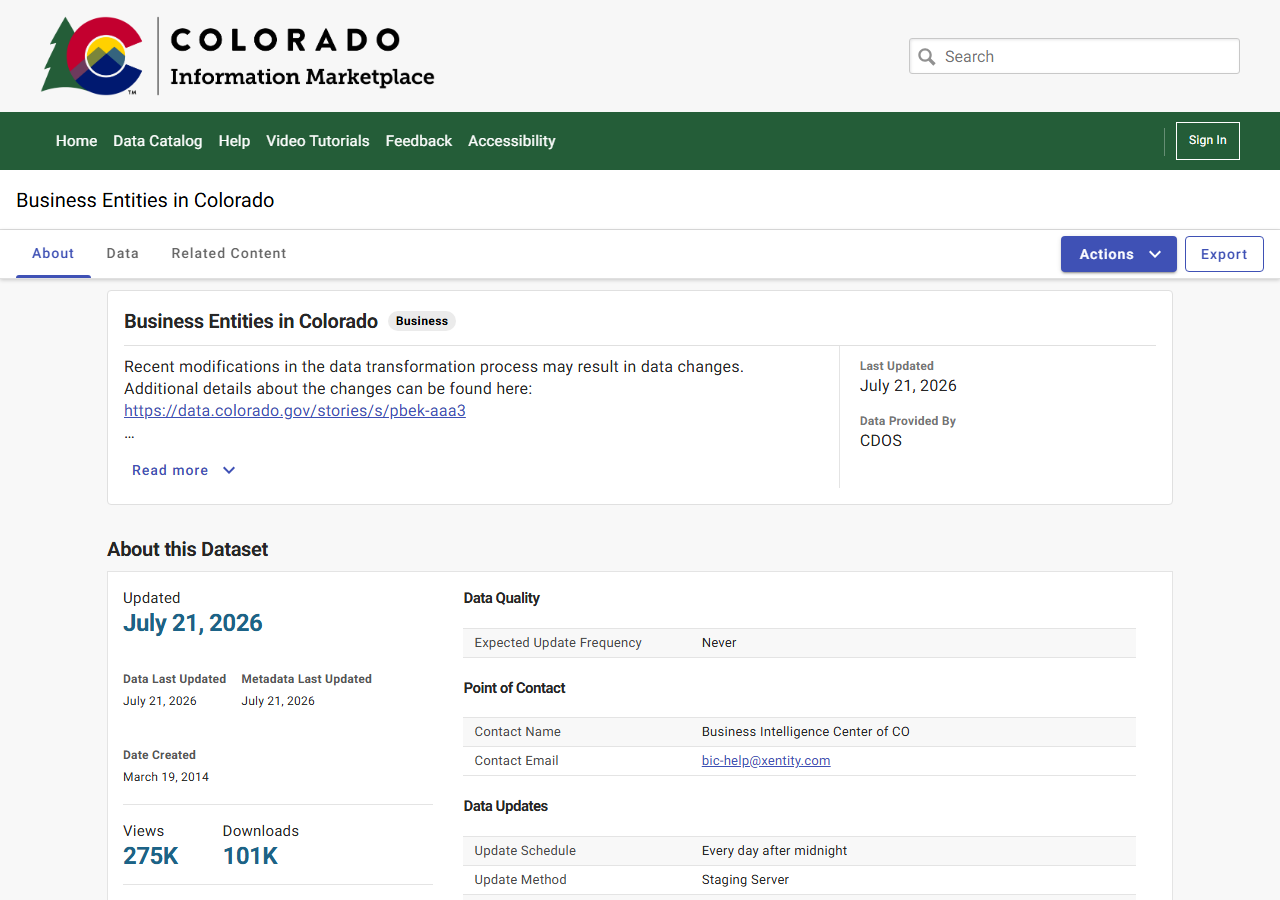
Every one of these registries has a public name search, and for one lookup in one state it is perfectly good. If you have a single company and know the state, use the state’s own search — it is authoritative and free.
It stops being reasonable when you do not know which state, or when the answer is a set rather
than a record. “Every entity with Kylderon in the name” means running the same search on three
portals, reading three differently-shaped result tables, and assembling the comparison by hand.
Repeat that per due-diligence request and it becomes the job.
The faster way
Multi-State Corporate & Business Entity Registry (CO, CT, OR) runs one name substring across all three registries and returns a single normalised table.
{
  "states": ["CO", "CT", "OR"],
  "query": "construction",
  "maxResults": 100
}
query is a substring match, not an exact one — which is the point. Searching construction
returns every entity with that word anywhere in its registered name, so you see the whole family of
similarly-named companies rather than only the one you already knew about. Narrow states when you
know the jurisdiction; leave all three when you do not.
What comes back
{
  "state": "CO",
  "entity_id": "20251665680",
  "entity_name": "KYLDERON MIST VALLEY LLC",
  "entity_type": "DLLC",
  "status": "Good Standing",
  "formation_date": "2025-06-16T00:00:00.000",
  "principal_address": "660 Willow Wood Ln",
  "principal_city": "Delta",
  "agent_name": "KEQIANG DENG"
}| Field | Why it matters here |
|---|---|
status | Good Standing vs delinquent or dissolved — usually the actual question |
formation_date | A company claiming twenty years of trading that filed last year is worth a second look |
entity_id | The state’s own identifier, for citing the record in a file |
principal_address | Shared addresses are how related entities give themselves away |
agent_name | So are shared registered agents |
source_url | Links back to the official record, so your finding is checkable |
status and formation_date answer most due-diligence questions. principal_address and
agent_name are what reveal that four differently-named companies are one operation.
What you’d do with it
Drop the result into the diligence file with the source_url beside each row, so the finding can be
re-checked by whoever reads it after you. If several entities share an address or an agent, that is
the thread to pull. And if the entity you were given does not appear at all, that is itself worth
noting — though read the caveat below before you write it down as a conclusion.
Worth knowing
Three states, not fifty. Colorado, Connecticut and Oregon. A no-match tells you the entity is not registered in those three — nothing about the other forty-seven.
Not-found is not proof of anything. Companies register in one state and trade in another, use legal names sharing no words with their trading name, and file under holding companies. Absence from a name search is a prompt to look harder, not a finding.
Substring matching cuts both ways. A short query returns plenty of unrelated companies that
happen to contain those letters. Longer, more distinctive phrases give cleaner results.
This is a registry, not a credit check. Status means the entity’s filings are current. It says nothing about solvency, litigation, or whether anyone should trade with them.
Run it yourself: How to run Multi-State Corporate & Business Entity Registry (CO, CT, OR) covers every input.
Chasing newly-formed companies rather than a specific name? Daily Delta: New Business Entities filters by formation date instead. To verify a licensed trade rather than a registered entity, Nevada Contractor License Lookup & Verify (NSCB) is the equivalent check against a contractor board.
Last updated 2026-07-22