Use case
Pull Colorado Business Entity Registrations
Pull Colorado's registered business entities into a spreadsheet — for sizing a market, mapping where companies actually are, or checking what a state's formation data really contains.
Before you commit a territory to a rep, or price a product for a state, you want to know what is actually there. How many entities are forming, of what type, in which counties. That is a market-sizing question, not a lead-gen one — you need a representative slab of the registry, not a timed drip of yesterday’s filings.
The same question comes up when someone hands you a data vendor’s pitch. Knowing what the state itself publishes, for free, is how you judge whether the vendor is adding anything.
The manual way, and what it costs
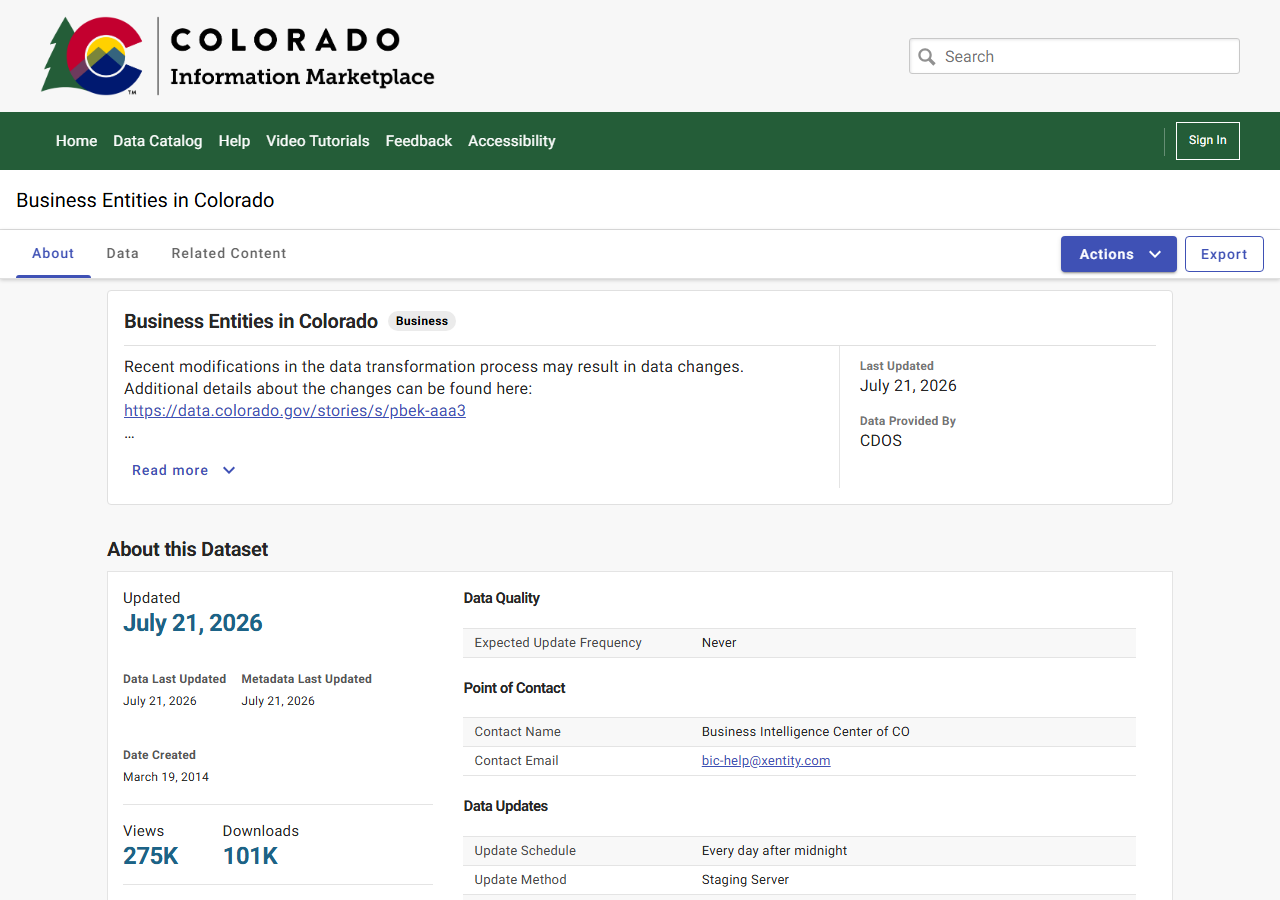
Colorado’s registry is open data and the portal genuinely works. You can filter and export a CSV without writing anything, and for a one-off slice that is the right tool — go and use it. This page is not going to pretend otherwise.
Where it costs you is repetition and shape. The export is Colorado’s column names, which do not match Connecticut’s or Oregon’s, so a comparison across states needs renaming before it needs analysis. And if the pull is something you re-run — quarterly sizing, a refreshed territory map — you are re-doing the browser steps each time rather than running something.
The faster way
Multi-State Corporate & Business Entity Registry (CO, CT, OR) pulls Colorado alone, in the same normalised shape the other two states come back in.
{
  "states": ["CO"],
  "maxResults": 100
}
One state, no date filter, bounded by maxResults — the newest registrations first. Raise
maxResults for a bigger sample; the cap exists so a sizing exercise does not turn into a full
registry dump you did not intend to pay for. Because the output shape is identical across states,
the same analysis runs unchanged when you add CT and OR later.
What comes back
{
  "state": "CO",
  "entity_id": "20251665680",
  "entity_name": "KYLDERON MIST VALLEY LLC",
  "entity_type": "DLLC",
  "status": "Good Standing",
  "formation_date": "2025-06-16T00:00:00.000",
  "jurisdiction": "CO",
  "principal_city": "Delta",
  "principal_zip": "81416"
}| Field | Why it matters here |
|---|---|
entity_type | The mix of LLCs, corporations and non-profits — the shape of the market |
principal_city / principal_zip | Where entities actually sit, for territory maps |
formation_date | Formation rate over time, if you pull enough rows |
status | What share of the registry is current rather than lapsed |
jurisdiction | Domestic vs foreign entities — companies formed elsewhere but registered here |
For sizing, entity_type and principal_city do most of the work: they answer “how many, of what
kind, and where” in a pivot table.
What you’d do with it
Put it in a spreadsheet and pivot principal_city against entity_type — that is your territory
map. Then re-run it against CT and OR and stack the results, since the columns already line up.
If the numbers are smaller than a vendor’s pitch implied, you have your answer about the vendor.
Worth knowing
Newest first, bounded by maxResults. This is a sample, not a census. Do not report a count
from it as “the number of businesses in Colorado” — it is the number of rows you asked for.
jurisdiction is not principal_state. An entity can be formed elsewhere and registered in
Colorado. If you are counting Colorado companies, decide which of those you mean before counting.
No contact details. State registries publish addresses, not phone numbers or emails.
Registered ≠ trading. Entities form and never operate, and stay listed long after they stop.
status narrows this but does not settle it.
Run it yourself: How to run Multi-State Corporate & Business Entity Registry (CO, CT, OR) walks every input.
Want new filings on a schedule instead of a sample? Daily Delta: New Business Entities filters by formation date across all three states. Sizing a contractor market specifically? Oregon Contractor Directory & Leads Scraper does the same job against a licensing board rather than a business registry.
Last updated 2026-07-22