Use case
Compare Two Competitor Apps' Reviews
Drop in two apps for a side-by-side competitive battlecard from their reviews — where each wins and what users complain about.
You’ve been asked to write the battlecard. Two apps, head to head — say Slack and Microsoft Teams — and sales wants a page they can actually use on a call: where the other side is weak, what their users grumble about, and which of their strengths your rep needs an answer for. The marketing sites are no help; both of them claim everything. The one place both products get described by people with no incentive to be kind is their store reviews.
The manual way, and what it costs
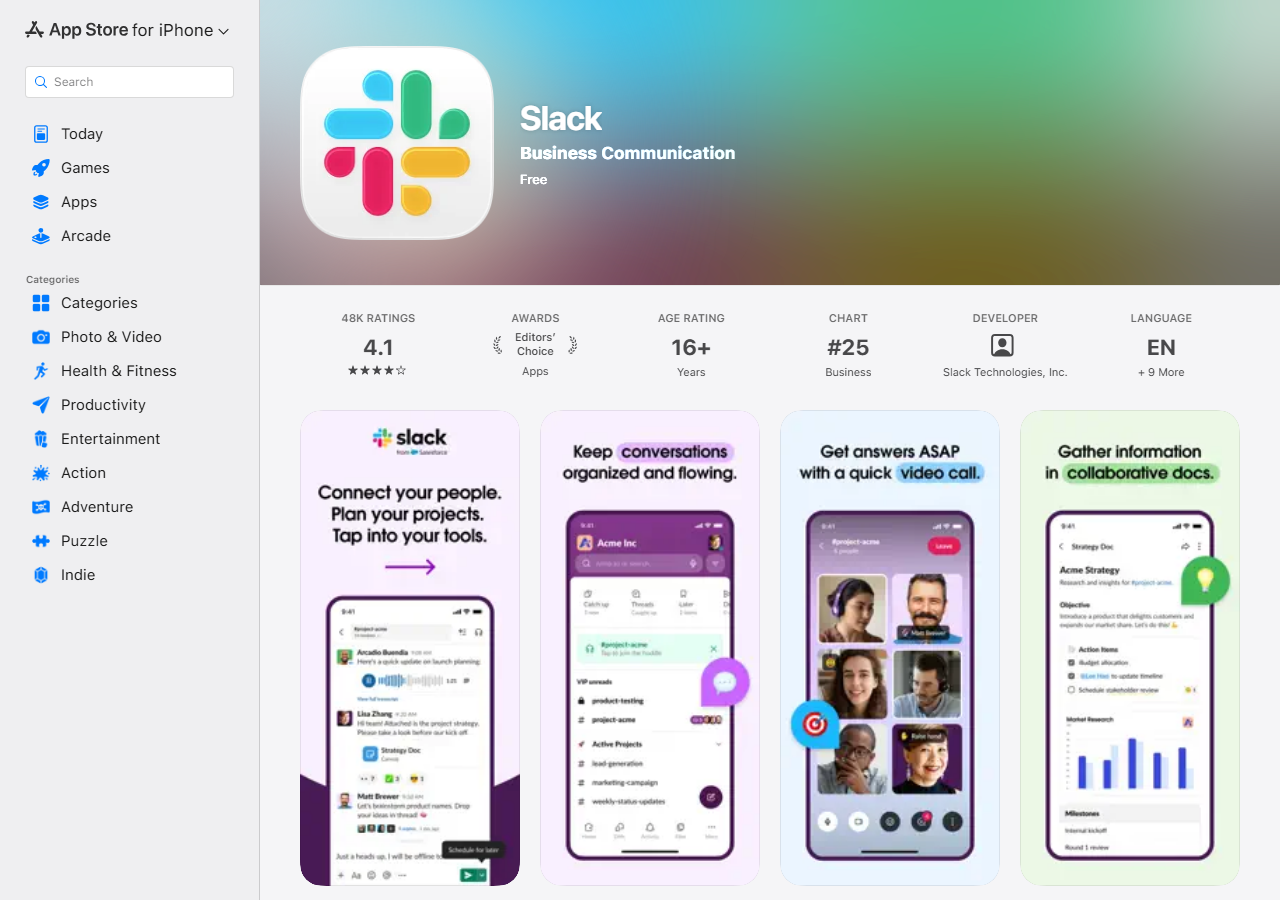
Both store pages are one search away and cost nothing to open. Above is Slack’s — 4.1 stars from 48K ratings, per the store’s own headline numbers — and Teams has a page just like it. So you open two tabs, hit “See All” under the reviews on each, and start scrolling. Nothing is hidden; there’s just no export, no filter, and no way to line the two up. The comparison — the part sales actually needs — happens in your head, or in a spreadsheet you build by hand, twice.
Doing that by hand is a perfectly good way to spend an hour if you want a rough feel for two apps, and you’ll pick up phrasing you can steal for the card. It stops being sensible when you need the two review sets ranked and aligned: complaint for complaint, strength for strength, on the same page, across a hundred reviews each. That’s the part that turns an hour into an afternoon — and you’ll be asked to redo it the next time either product ships a release.
The faster way
App Review Teardown & Insights (AI) does the same search once and hands back every row at once.
{
  "apps": [
    "Slack",
    "Microsoft Teams"
  ],
  "compareToPrevious": false
}
Two apps in one run. Because apps has more than one entry and compareApps is on by default, the
run emits a teardown for each app plus a third (comparison) record: a strengths/weaknesses matrix
across both, and a battlecard per competitor — their weaknesses, and the strengths of theirs you need
a counter for. Add yourApp and name one of the entries as your own, and the battlecards are reframed
as you vs each competitor, filling in a your_advantages list; leave it out, as here, and you get a
neutral read of both. compareToPrevious is off because this is a one-shot; turn it on and schedule
the run if the battlecard is a living document. Note the billing shape while you’re here: this run
produces three AI insights — two teardowns and the comparison — so it’s three events, not two.
What comes back
{
  "app": "Notion",
  "app_name": "Notion: Notes, Tasks, AI",
  "apple_id": "1232780281",
  "sources": [
    "apple"
  ],
  "overall_rating": 4.78,
  "review_count_analyzed": 100,
  "teardown": {
    "summary": "Notion is praised as a powerful, flexible workspace but is dragged down by mobile bugs, a steep learning curve, and an intrusive AI button.",
    "strengths": [
      "Powerful, flexible all-in-one workspace",
      "Great for notes, tasks, and databases"
    ],
    "weaknesses": [
      "Buggy on iOS/iPad with crashes",
      "Steep learning curve on mobile",
      "Intrusive AI chat button"
    ],
    "top_complaints": [
      "app crashes / bugs",
      "confusing mobile navigation",
      "free-tier upload limits"
    ],
    "feature_requests": [
      "offline mode",
      "remove/hide the AI button",
      "better mobile editor"
    ],
    "themes": [
      {
        "theme": "Bugs and crashes",
        "sentiment": "negative",
        "mentions": 6
      },
      {
        "theme": "Power and flexibility",
        "sentiment": "positive",
        "mentions": 5
      }
    ],
    "sentiment_score": 62
  },
  "first_seen": false,
  "rating_delta": -0.03,
  "emerging_complaints": [
    "app crashes / bugs"
  ],
  "resolved_complaints": [],
  "sentiment_delta": -4,
  "source_url": "https://apps.apple.com/us/app/id1232780281"
}| Field | Example value | Meaning |
|---|---|---|
app | Notion | The app reference you supplied |
app_name | Notion: Notes, Tasks, AI | Resolved app name |
sources | ["apple"] | Stores that contributed reviews (apple, gplay) |
overall_rating | 4.78 | Store-reported average rating |
review_count_analyzed | 100 | Reviews fed to the AI |
teardown.summary | — | One-paragraph competitive summary |
The per-app records above are the raw material — teardown.strengths, teardown.weaknesses,
teardown.top_complaints for each app, with overall_rating and review_count_analyzed telling you
what the store reports and how much text each summary was built from. The record that closes the loop
is the extra (comparison) one: comparison.matrix lines the two apps up strength-for-strength and
weakness-for-weakness, and comparison.battlecards turns that into the page sales asked for — a
competitor, their weaknesses, and the watch-outs your rep should have an answer ready for.
What you’d do with it
Paste comparison.battlecards into the card template, one section per competitor, and put the
matrix underneath as the evidence. Then do the part that makes it credible: open each app’s
source_url, find two or three verbatim reviews behind the weaknesses you’re leaning on, and quote
those on the card. A rep repeating a real user’s sentence back on a call lands; a rep reading an AI
bullet point does not.
Worth knowing
Every word of this comes from public app-store reviews — Apple’s official feed, plus Google Play best-effort — so it’s what reviewers wrote, not internal metrics, not win rates, and not anything about the enterprise buyers who never review an app. Both apps get the same treatment, which makes the comparison fair, but it also means an app whose users don’t review much looks quieter than it is.
And the battlecard is generated by an LLM — twice over, in fact: the model summarises each app’s
reviews, and then summarises those summaries into the comparison. It’s told to use only what it was
given, but a synthesis of a synthesis can drift from the source, and it can miss nuance. This is a
fast read of two review corpora, not a measurement of them. Do not put an AI-written weakness in front
of a customer without checking it against the actual reviews first — the source_url on each record is
there for exactly that. The sample is capped by maxReviews and always most-recent-first; apps that
can’t be resolved or have no reviews come back empty and aren’t charged.
Run it yourself: How to run App Review Teardown & Insights (AI) walks the whole thing step by step.
If you only care about one side of the fight, AI Teardown of an App’s App Store Reviews runs a single app and skips the comparison; to point it inward at your own reviews for planning, see Find the Top Complaints in an App’s Reviews. Building the same card against a competitor who sells online rather than shipping an app? Shopify Store Intel tears down the storefront instead.
Last updated 2026-07-13