Use case
Open Roles From a Workday Careers Site
Workday boards hold some of the largest job counts and need their careers URL rather than a domain. Paste the URL and get the roles.
The large employers on your list are the ones you most want to map, and they are the ones that tend to run Workday. That is where the volume is: one NVIDIA Workday site held 2,000 open roles when it was checked on 6 September 2026.
It is also where the domain trick stops working. Give this actor stripe.com and it finds the
board on its own. Give it nvidia.com and it cannot — and the reason is worth understanding,
because it is the difference between a tool that guesses and one that tells you.
The manual way, and what it costs
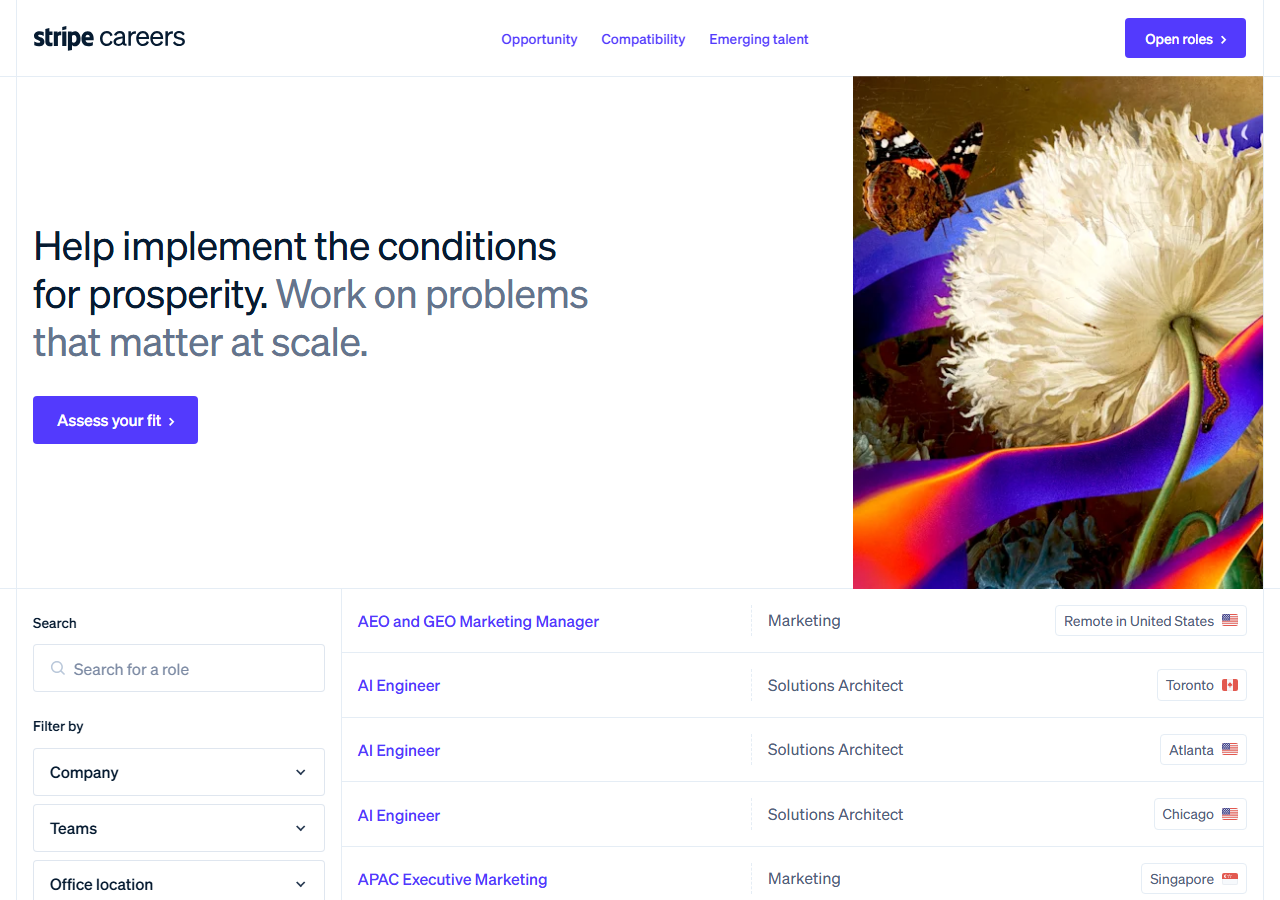
Workday sites are public and you can browse them. But they page twenty roles at a time, so a 2,000-role site is a hundred clicks before you have seen everything, and there is no export button at the end of it.
The addressing is the real obstacle to automating it yourself. A Workday board is not identified by
the company — it needs a tenant name, a numbered pod (wd1, wd5, and so on) and a site name, all
three of which appear only in the careers URL. None of that is derivable from nvidia.com, which
is why this actor asks you for the URL instead of pretending it can work it out.
The faster way
ATS & Career Page Jobs Scraper (Greenhouse, Lever, Workday) does the same search once and hands back every row at once.
{
  "company": "https://nvidia.wd5.myworkdayjobs.com/en-US/NVIDIAExternalCareerSite",
  "maxResults": 100
}
Paste the careers URL exactly as it appears in your browser when you land on the employer’s
Workday site. The tenant, the pod and the site name are all in there, and the actor takes them from
the URL rather than guessing. maxResults is a per-company cap — useful here precisely because
these sites are large; the run log always states the site’s own total next to the number returned,
so you can see what you capped.
What comes back
{
  "source_url": "https://job-boards.greenhouse.io/vercel/jobs/6136160004",
  "company": "vercel.com",
  "company_name": "Vercel",
  "ats": "greenhouse",
  "ats_slug": "vercel",
  "detected_by": "slug_match",
  "job_id": "6136160004",
  "title": "Account Executive, Commercial",
  "department": "Account Executive",
  "team": null,
  "location": "Hybrid - London",
  "locations": [
    "Office - London"
  ],
  "remote": null,
  "employment_type": null,
  "posted_at": "2026-08-06T12:50:10-04:00",
  "posted_text": null,
  "updated_at": "2026-08-18T18:06:19-04:00",
  "apply_url": "https://job-boards.greenhouse.io/vercel/jobs/6136160004",
  "requisition_id": null,
  "description": null
}| Field | Example value | Meaning |
|---|---|---|
company | vercel.com | The value you submitted — domain, careers URL or explicit board |
company_name | Vercel | Employer name as the board states it (Greenhouse and SmartRecruiters publish it; Ashby, Lever and Workday do not, so it is null there) |
ats | greenhouse | greenhouse, lever, ashby, smartrecruiters or workday |
ats_slug | vercel | The board identifier on that ATS |
detected_by | slug_match | How the board was matched: explicit, careers_page, or slug_match |
job_id | 6136160004 | The board’s own job identifier — stable across runs, so it de-duplicates |
title, location and apply_url are filled on every row, and requisition_id carries the
employer’s own internal reference — useful when you are talking to someone inside the company who
knows the req number but not the job title.
One column behaves differently here and you should know why. Workday does not publish a posting
date; it publishes a phrase like “Posted Today”. So posted_at is null on these rows and
posted_text holds the phrase verbatim. Converting “Posted Today” into a date would look tidier
and would be a number nobody actually stated.
What you’d do with it
Export to CSV or pull from the API, then group by department and location to see where a large employer is actually investing — which is far more legible from 2,000 rows in a sheet than from a hundred pages of a careers site. Because the rows share a schema with the Greenhouse, Lever, Ashby and SmartRecruiters output, a Workday employer sits in the same table as everyone else on your list.
Worth knowing
Workday rows are the sparsest of the five systems. No posting date, as above. No employer name
from the board, so company_name is null. No remote flag either — where it is set, it has been
read from the location wording rather than a field, and a location that says nothing about remote
work leaves it null rather than guessing false.
There is no salary data anywhere in this actor, and no model-generated enrichment of any kind. And you must supply the careers URL: a bare company domain will not resolve to a Workday board, and you will get a free row telling you so rather than an empty result.
Run it yourself: How to run ATS & Career Page Jobs Scraper (Greenhouse, Lever, Workday) walks the whole thing step by step.
Every open job at a company, from its career page — for the employers whose board is found from the domain alone, which is most of them.
Business Email & Phone Contact Details Scraper — when you need contact details for those employers rather than their open roles.
Last updated 2026-09-06