Use case
List Louisiana Commercial Contractors by Parish
Pull active Louisiana LSLBC commercial licence holders for one parish - classifications, qualifying parties, expiration and contact details in a single export.
Say you rent scaffolding and lift equipment out of a yard in Covington, and you want a call list of every active commercial contractor registered in St Tammany Parish before the next build season starts. Not “contractors near me” off a maps scrape — the ones the state has actually licensed for commercial work, with the trades they are classified for, so you know whether to lead with a boom lift or a mast climber. Louisiana publishes exactly that, and the parish is a field on the record. Getting it out one search at a time is the problem.
The manual way, and what it costs
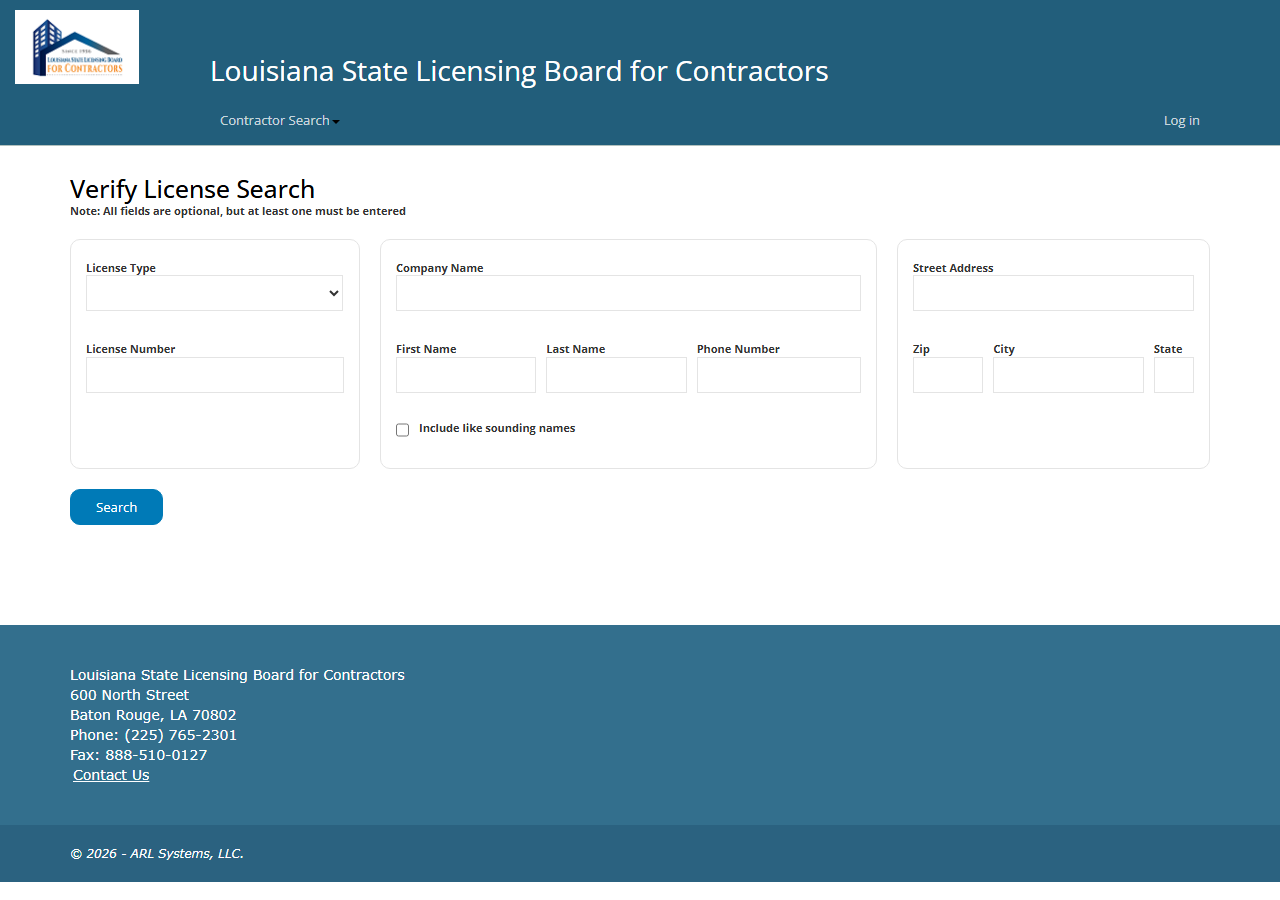
LSLBC’s public search is free and it is the authoritative record. If you have one licence number to check before signing a subcontract, use it — you will have your answer in under a minute and nothing here beats it for that.
It is a different tool for a list. Results come back a screenful at a time, and reading a whole parish off it means paging, clicking in for the classifications, and copying into a spreadsheet by hand. There is a second, less obvious route: the same portal will generate a roster export, and for the standard roster the fee it quotes is $0.00 — so the raw data is genuinely free to anyone willing to go and get it. The catch is what lands in the file. The roster is one row per classification per qualifying party, so a contractor with three classifications and two qualifying parties appears six times, and your parish is mixed in with the other 63. Deduplicating that into one row per licence and filtering it down is the actual work.
The faster way
Louisiana Contractor License Lookup does the same search once and hands back every row at once.
{
  "contractorTypes": [
    "commercial"
  ],
  "statusFilter": "Active",
  "parishFilter": "St Tammany",
  "maxResults": 500
}
contractorTypes: ["commercial"] is the whole point of the run — Louisiana issues four separate
certificate types, and a residential or home-improvement registration is not a lead for commercial
lift rental. statusFilter: "Active" drops the lapsed rows; it is an exact, case-insensitive match
on the status word the roster prints, not a fuzzy one. So is parishFilter: "St Tammany" has to
match the parish name as LSLBC spells it, so an empty run is far more often a spelling variant
(St versus St.) than an empty parish — check one unfiltered row first if you are unsure.
maxResults: 500 is the spend ceiling, since you are charged per record that comes back.
What comes back
{
  "license_number": "68755",
  "company_name": "09 Construction Services, LLC",
  "status": "Active",
  "contractor_type": "Commercial License Certificate",
  "parish": "Bossier",
  "city": "Bossier City",
  "state_code": "LA",
  "phone": "(318) 564-8455",
  "email": "09construction@gmail.com",
  "classifications": [
    "BUILDING CONSTRUCTION",
    "HEAVY CONSTRUCTION",
    "HIGHWAY, STREET AND BRIDGE CONSTRUCTION"
  ],
  "qualifying_parties": [
    "Kent Gardner Jones"
  ],
  "effective_date": "07/19/2026",
  "expiration_date": "07/18/2029",
  "first_effective_date": "07/18/2019",
  "out_of_state": false,
  "address": "1009 Creole Drive",
  "zip_code": "71111",
  "source_url": "https://arlspublic.lslbc.louisiana.gov/Public/Search"
}| Field | Example value | Meaning |
|---|---|---|
license_number | 68755 | LSLBC license number |
company_name | 09 Construction Services, LLC | Registered business name |
status | Active | Active, Expired, etc. |
contractor_type | Commercial License Certificate | Commercial / Residential / Home Improvement / Mold Remediation |
parish | Bossier | Louisiana parish where the contractor is registered |
city | Bossier City | Mailing city |
classifications decides who you ring first. It arrives as a list, already collapsed from the
roster’s repeated rows, so HEAVY CONSTRUCTION and HIGHWAY, STREET AND BRIDGE CONSTRUCTION on one
record tell you this is an equipment-heavy outfit and not a fit-out shop. phone and email come
straight off the licence — unusual for a state register, and what makes this a list you can act on
rather than one you then have to enrich. qualifying_parties gives you the named individual the
licence hangs on, which beats “to whom it may concern”.
What you’d do with it
Export the dataset to CSV and import it as a territory list: company, phone, email, city,
classifications, licence number. Segment on classifications so the heavy-civil records get a
different opening line from the building-construction ones, and keep license_number as the dedup
key when the same contractor turns up again from a later run. If you re-run it quarterly, diff the
new export against the last: new licence numbers in the parish are new businesses to call, and
records that drop out of Active are ones to stop calling.
Worth knowing
Filtering does not make the run smaller, only cheaper. The actor downloads the entire roster for every contractor type you ask for — 50,000-plus rows across all four — and filters it locally. A one-parish run takes the same time and compute as a statewide one; what the filters bound is how many records you are charged for.
It is a snapshot, taken at run time. A licence that lapses tomorrow reads Active in today’s
export. Status changes only appear on the next run, so a compliance file built from one run has a
date on it, not a guarantee.
No bond, no insurance, no workers’ comp. The LSLBC roster does not carry them, so nothing here tells you a contractor is insured. That check is separate and this actor does not do it.
One row per licence, by design. The roster’s per-classification and per-qualifying-party rows are
collapsed into lists. If you wanted the exploded shape back, you have to explode it yourself. And the
statusFilter / parishFilter comparisons are whole-value matches, not substrings — a near miss
returns nothing rather than something approximate.
Run it yourself: How to run Louisiana Contractor License Lookup walks the whole thing step by step.
- Texas Contractor Directory & Leads Scraper (TDLR) — the same parish-style list job one state west, when your territory crosses into Texas.
- Business Email & Phone Contact Details Scraper
— reach for it when a licence row has no
emailand you have the company’s website instead.
Last updated 2026-07-22