How-to
How to run Recently Funded Companies Lookup & Leads Scraper (SEC Form D)
Step-by-step: the exact input, what each field does, and the rows that come back from SEC EDGAR (Form D).
You sell something a company buys right after it raises money (payroll, cloud credits, an office, a recruiter), and you want the list of companies that just raised. Every US private company selling securities under Regulation D files a Form D with the SEC within 15 days of its first sale, so the list exists: 15,952 Form D filings went in during the third quarter of 2026. Getting it by hand means EDGAR’s search, one filing at a time, or the SEC’s quarterly data set, a ZIP of six tab-separated tables you join yourself.
What you’ll need
Nothing but an Apify account. The actor talks to SEC EDGAR (Form D) directly.
There is no API key to get and no proxy to turn on: the SEC’s files are public, and the actor identifies itself to the SEC the way its fair-access policy asks, staying under 10 requests a second. The proxy setting stays off unless a run tells you the SEC refused it.
Step 1 — Open the actor
Open Recently Funded Companies Lookup & Leads Scraper (SEC Form D) on the Apify Store and press Try for free. The actor’s own page on this site lists its live health and pricing.
Step 2 — Fill in the input
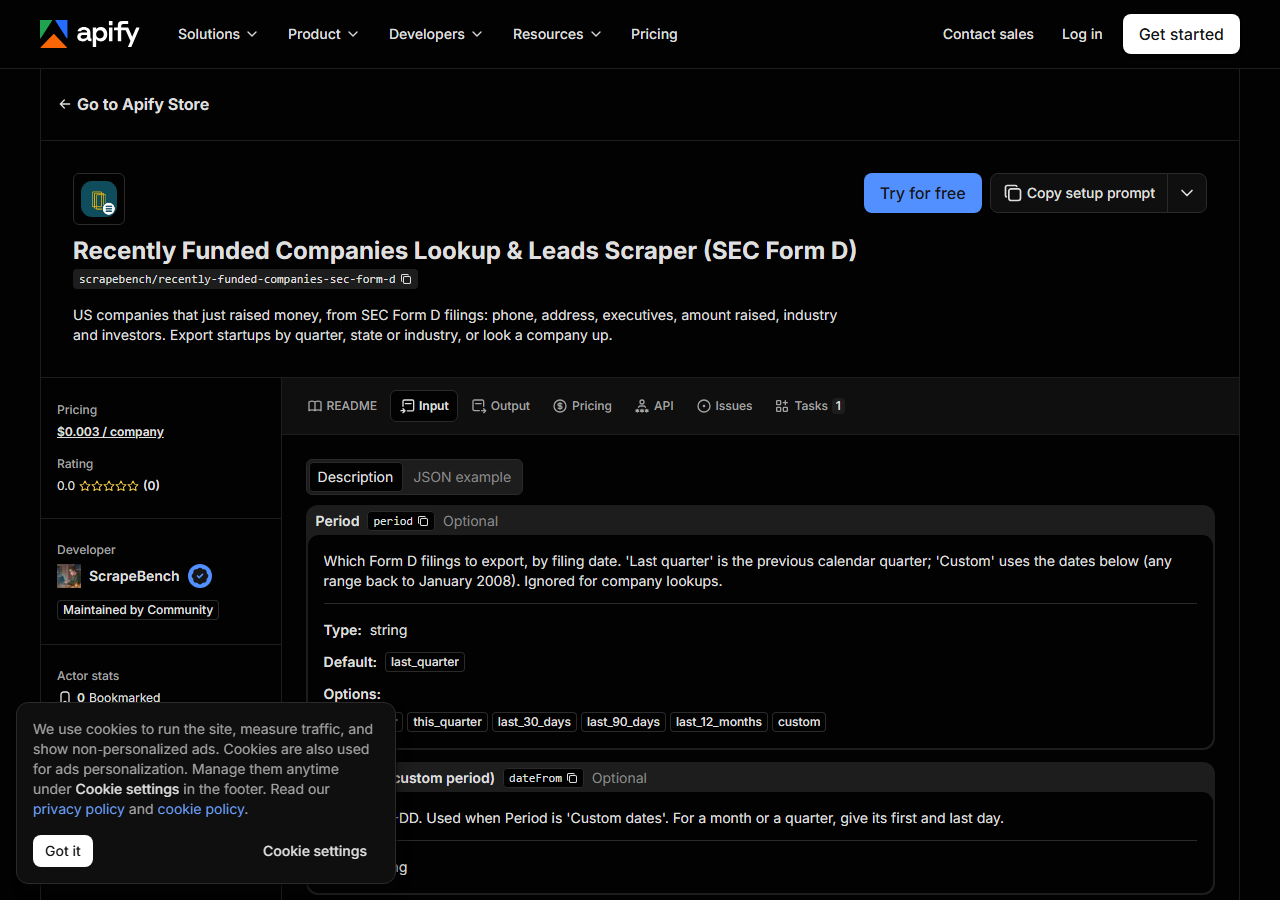
| Field | Type | Required | What it does |
|---|---|---|---|
period | string | no | Which Form D filings to export, by filing date. ‘Last quarter’ is the previous calendar quarter; ‘Custom’ uses the dates below (any range back to January 2008). Ignored for… (default last_quarter) |
dateFrom | string | no | YYYY-MM-DD. Used when Period is ‘Custom dates’. For a month or a quarter, give its first and last day. |
dateTo | string | no | YYYY-MM-DD. Defaults to today. |
preset | string | no | ’Startups’ = companies incorporated within the last five years, filed as a Corporation, in an operating industry (no funds, real estate or investing vehicles). Your own… (default startups) |
minAmountSold | integer | no | Only companies that have already sold at least this much in the offering (the filing’s ‘total amount sold’, not the amount offered). |
industries | array | no | The SEC’s own Form D industry groups, e.g. ‘Other Technology’, ‘Biotechnology’, ‘Other Health Care’, ‘Manufacturing’, ‘Business Services’, ‘Computers’, ‘Retailing’,… (default []) |
states | array | no | Two-letter codes of the company’s business address, e.g. [‘CA’, ‘NY’, ‘TX’]. Leave empty for all. (default []) |
nameKeywords | array | no | Keep companies whose NAME contains one of these words, e.g. [‘AI’, ‘Health’, ‘Robotics’]. This matches the name only: Form D has no business description. (default []) |
excludeFunds | boolean | no | Pooled investment funds (venture, private equity, hedge funds and SPVs) are about two thirds of all Form D filings. On by default. Picking ‘Pooled Investment Fund’ under… (default True) |
youngCompaniesOnly | boolean | no | Only issuers that tick ‘within the last five years’ on the filing. |
entityTypes | array | no | Corporation, Limited Liability Company, Limited Partnership, General Partnership, Business Trust or Other. Leave empty for all. (default []) |
newFilingsOnly | boolean | no | Only original Form D notices, not Form D/A amendments. Off: a company that amended its filing in the period is included, with the amended amounts. |
companies | array | no | Look up specific companies instead of exporting: exact company names (e.g. ‘Cala Systems’) or SEC CIK numbers. Each returns the company’s latest Form D and its raise history.… (default []) |
company | string | no | One company name or CIK; kept for saved tasks and API callers that send one value. Combined with ‘Company lookup’. |
maxResults | integer | no | Spend cap for the whole run. The newest filings come first. Last quarter (2026 Q3) had about 4,800 companies that were not funds, and 613 startups that raised $1M or more. (default 1000) |
Two fields decide most of what you get. preset defaults to Startups: companies incorporated in the
last five years, filed as a Corporation, outside funds, real estate and investing. Set it to none
and the same quarter grows from 613 rows to every non-fund raise (4,775 companies in 2026 Q3). The
second is minAmountSold, which reads the amount already sold, not the amount offered; a $10M
offering that has sold $300,000 does not pass a $1M filter.
Put names or CIK numbers in companies and the actor switches to lookups instead, ignoring the
export filters. A name must match the SEC’s spelling apart from suffixes like Inc. or LLC, so
“Cala Systems” finds Cala Systems, Inc. and not “Cala Systems I, a series of Capitalize Investments
LLC”.
A working input:
{
  "period": "last_quarter",
  "preset": "startups",
  "minAmountSold": 1000000,
  "maxResults": 1000
}
Step 3 — Run it
Press Start. Rows are pushed to the dataset as they’re found, so the run log fills in as it works.
A closed quarter is quick: the input above returned 613 companies in 3.9 seconds in our test on 2026-10-30, because the whole quarter comes from one 3.7 MB SEC file. The current quarter is slower, since the SEC has not published its file yet and every filing is read on its own. Our last-30-days test with the keyword “AI” read 66 filings and kept 34 companies in 9.9 seconds; a whole month with no keyword is about 5,300 filings, roughly ten minutes at the SEC’s rate limit.
An empty result comes back as one free row that names the period and says nothing matched. That almost always means the filters are tighter than the quarter, for example a $5M minimum in a single small state.
Step 4 — Read the output
Each run returns a labelled table, not raw JSON:
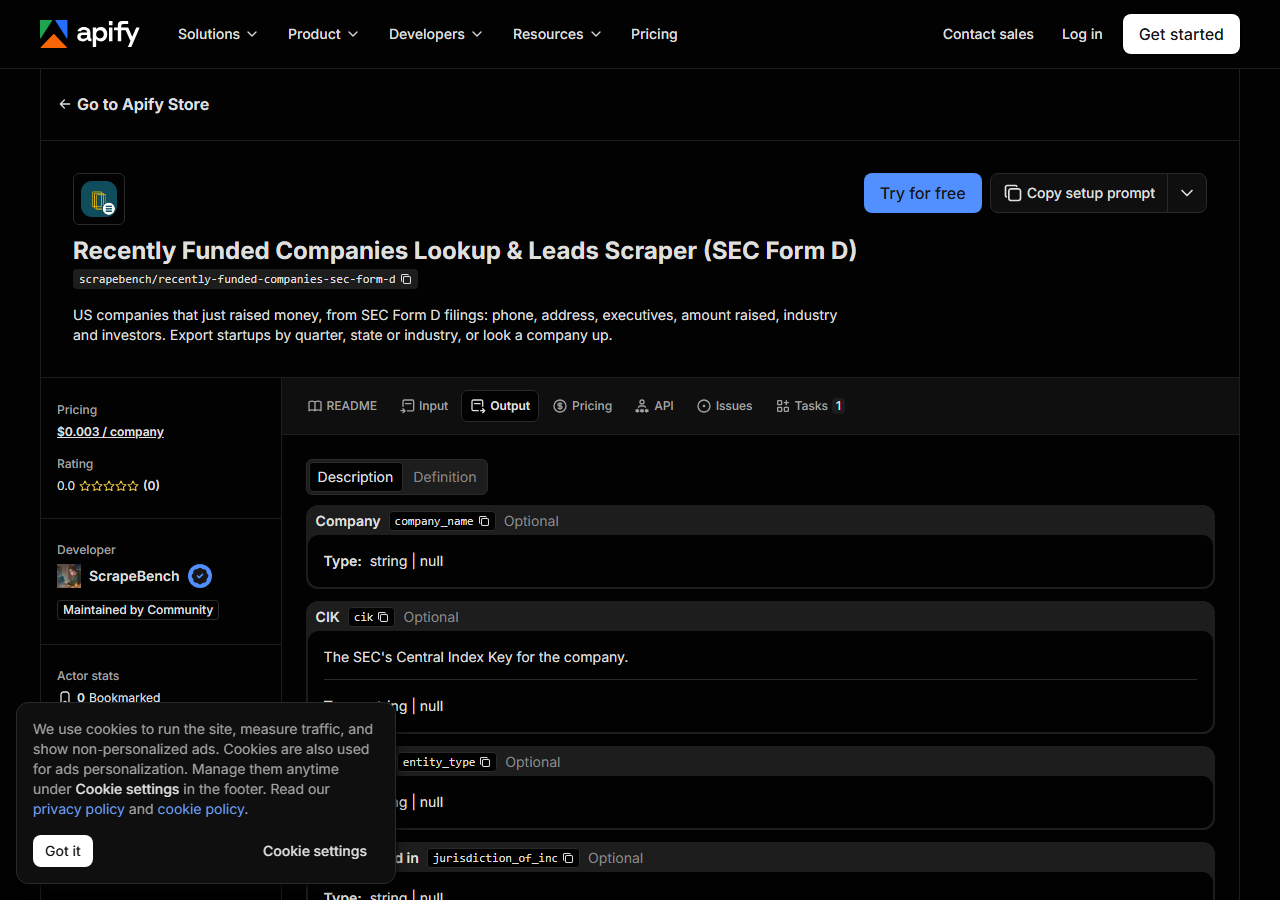
Every row looks like this — a real row from a real run:
{
  "company_name": "RunLoyal, Inc.",
  "cik": "2157791",
  "entity_type": "Corporation",
  "jurisdiction_of_inc": "DELAWARE",
  "year_of_inc": 2026,
  "incorporated_within_five_years": true,
  "street": "955 CROFTERS PASS",
  "city": "ALPHARETTA",
  "state": "GA",
  "zip": "30022",
  "phone": "404-999-0461",
  "industry": "Other Technology",
  "is_investment_fund": false,
  "securities_offered": [
    "Equity"
  ],
  "federal_exemptions": [
    "06b"
  ],
  "total_offering_amount": 1267339,
  "total_amount_sold": 1167339,
  "total_remaining": 100000,
  "investors_count": 3,
  "date_of_first_sale": "2026-09-17",
  "filing_date": "2026-09-30",
  "form_type": "D",
  "related_persons": [
    {
      "name": "Janakan Rajendran",
      "relationships": [
        "Executive Officer"
      ],
      "street": "955 Crofters Pass",
      "city": "Alpharetta",
      "state": "GA",
      "zip": "30022"
    }
  ],
  "filing_url": "https://www.sec.gov/Archives/edgar/data/2157791/000215779126000001/0002157791-26-000001-index.htm"
}| Field | Example value | Meaning |
|---|---|---|
company_name, cik | — | The company as filed, and its SEC Central Index Key |
phone | 404-999-0461 | Business phone from the filing (placeholders like 000-000-0000 are left empty) |
street, street2, city, state, zip | — | Business address |
related_persons | [{"name": "Janakan Rajendran", "relationships": ["Executive Officer"], "street": "955 Crofters Pass", "city": "Alpharetta", "state": "GA", "zip": "30022"}] | Executives, directors and promoters: name, role, title and address as filed |
total_amount_sold | 1167339 | Amount raised so far in the offering |
total_offering_amount, total_remaining | — | Amount offered and still to sell (empty when the offering is indefinite) |
investors_count | 3 | Investors who have already invested |
industry | Other Technology | The SEC’s Form D industry group, e.g. Other Technology, Biotechnology |
Most people came for phone and related_persons. The phone is as the company typed it, so formats
vary (“(480) 235-1420”, “4085089008”, “+1-661-465-3653”); 609 of the 613 startup rows had one, and
placeholders such as 0000000000 come back empty. related_persons names the executives and
directors with the address each gave on the filing. There is no email and no website on a Form D,
and the actor does not guess them.
Step 5 — Export it
Open the Dataset tab and export to CSV, JSON, or Excel — or pull the same rows from the API, which is what you want if this is going to run on a schedule.
What it costs
$0.003 per company delivered, in an export or a lookup. The 613 startups from 2026 Q3 cost about $1.84; every non-fund raise in that quarter (4,775 companies) would be about $14.33. Rows that only explain something are free: no match, a lookup that found nothing, a run stopped by its timeout or by your maximum. Apify’s platform usage is billed separately; our first customer-account run, three companies, finished in 11 seconds.
Where the data comes from
This reads SEC EDGAR (Form D) directly. The target is The SEC’s own published files: the quarterly Form D data set ZIP (tab-separated tables) for closed quarters, EDGAR’s quarterly form.idx plus each filing’s primary_doc.xml for the open quarter, and EDGAR’s entity search and submissions JSON for lookups; plain HTTP, no browser. Every night a canary runs this actor against that live source and diffs the result against a frozen fixture — what “verified” means.
The free data set is the honest alternative, and it is good: 75 quarters from 2008 Q1 on. It is also six tables keyed by accession number, two thirds of its rows are investment funds (10,487 of 15,952 in 2026 Q3), amendments repeat the same company, and each quarter appears about a month after it ends. The download links do not even follow one pattern, so the actor reads them off the SEC’s own page.
See it used
Startups That Raised $1M+ Last Quarter (SEC Form D) turns this input into a prospect list for a sales team.
Form D gives you a phone and names but no website or email. When you have found a company’s website, the Business Email, Phone & Contact Details Scraper reads its contact and team pages for emails.
Last updated 2026-10-30